The yield curve: what the market thinks about the future
· beginner
Automated material · TradeAlmanac editorial deskDraft prepared by a language model from our stored data; not reviewed by an editor.

Take government bonds of different maturities and plot their yields against time to maturity, and you get a curve. Its shape is the market's compressed opinion about the future price of money.
The normal shape
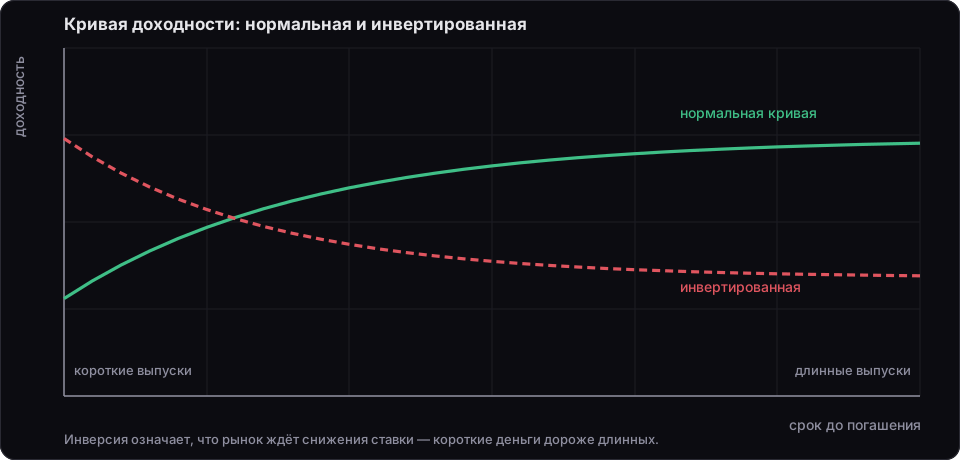
Long money usually costs more than short: a lender parting with money for longer demands a premium for uncertainty. The curve slopes upwards.
Inversion
When short yields exceed long ones, the market expects rates to fall. That usually happens after the regulator has raised rates to fight inflation and participants judge that it will not have to hold them there for long.
Historically an inversion has often preceded an economic slowdown — but the link is statistical rather than mechanical, and the gap between signal and event is measured in quarters.
What it gives an investor
Three practical things.
A reference for choosing maturity. Under an inversion a long issue offers no term premium — so there is nothing paying you for duration risk: Duration: why long bonds fall harder.
An estimate of expectations. If your view of the future rate differs from what the curve embeds, that difference is your position.
A basis for comparison. A corporate issue's yield is compared not with an abstract figure but with a government issue of the same maturity; the gap is the premium for credit risk: OFZ and corporate bonds: what the premium pays for.
Draft prepared by a language model from our stored data; not reviewed by an editor.
Model: claude-opus-5
How we use language modelsSimilar articles
- The secondary market for DFAs: why the asset never leaves its own platformA DFA can be sold before redemption only inside the platform where it was issued, and only through an exchange operator listed in the Bank of Russia register. Why the asset cannot be moved to another operator, how selling it differs from placing an order in a bond's order book, and what the sale changes in the purchase limit and in the tax.
- Terms of Trade: How the Ratio of Export to Import Prices Moves the Rouble and ProfitsThe terms of trade are the ratio between the prices at which a country sells its exports and the prices at which it buys its imports.
- TWAP order: the algorithm slices volume by time, not by liquidityA TWAP order (time-weighted average price) is an instruction to the trading system: take a large order, break it into a stream of small child orders and release them in equal portions at equal intervals until the end of a set window.
- The Impossible Trinity: What a Central Bank Pays for a Fixed Exchange RateThe impossible trinity is the proposition that, out of the set of goals "fixed exchange rate", "free movement of capital" and "independent interest rate", a state can hold any combination except the complete set.