Why the price of one share says nothing about the company
· beginner
Automated material · TradeAlmanac editorial deskPrepared by a language model from our stored data and checked by an editor.

Comparing securities by the price of a single unit is the most common and the most quickly corrected mistake. Seeing once what the price is made of is enough.
Capitalisation, not price
The value of a whole company is the price of one share multiplied by the number of shares.
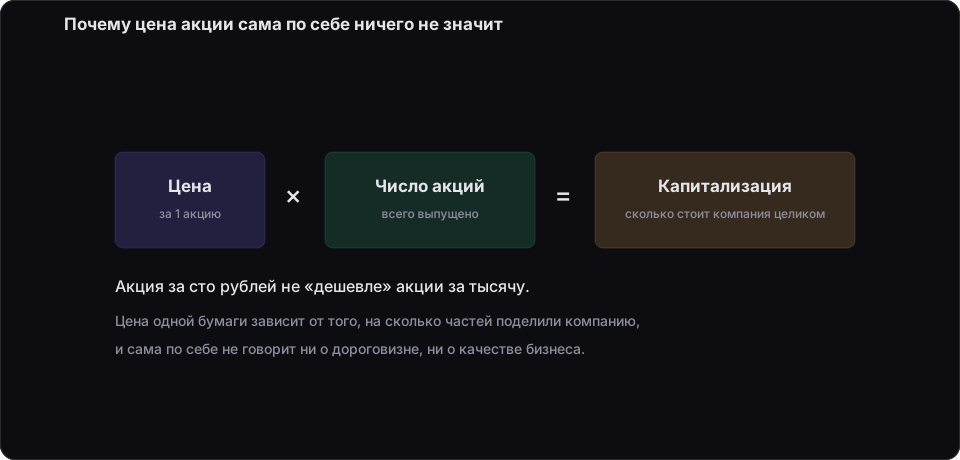
The same company can be divided into a million shares or a billion. In the first case the share is expensive, in the second it is cheap, and the company is exactly the same.
What a split does
Splitting shares increases their number and reduces the price of each proportionally. At the moment of the split the owner becomes neither richer nor poorer: more securities at a lower price.
How to compare properly
Not by price but by the ratio of price to something from the accounts — profit, revenue, equity. That is what multiples are for:
3,77
The details are in P/E: what it is and why low does not mean cheap.
A note on lots
Securities trade in lots on the exchange, and a lot may contain more than one share. That is another layer between the price on screen and the sum you will actually pay — and it has nothing to do with valuing the company either.
What to remember
Calling a share expensive or cheap is meaningless without relating it to business results. The only thing a three-digit or four-digit price tells you is how many shares were issued. On where to find the underlying data, see Where to find a Russian company's accounts.
Related instruments
Prepared by a language model from our stored data and checked by an editor.
How we use language modelsSimilar articles
- The secondary market for DFAs: why the asset never leaves its own platformA DFA can be sold before redemption only inside the platform where it was issued, and only through an exchange operator listed in the Bank of Russia register. Why the asset cannot be moved to another operator, how selling it differs from placing an order in a bond's order book, and what the sale changes in the purchase limit and in the tax.
- Terms of Trade: How the Ratio of Export to Import Prices Moves the Rouble and ProfitsThe terms of trade are the ratio between the prices at which a country sells its exports and the prices at which it buys its imports.
- TWAP order: the algorithm slices volume by time, not by liquidityA TWAP order (time-weighted average price) is an instruction to the trading system: take a large order, break it into a stream of small child orders and release them in equal portions at equal intervals until the end of a set window.
- The Impossible Trinity: What a Central Bank Pays for a Fixed Exchange RateThe impossible trinity is the proposition that, out of the set of goals "fixed exchange rate", "free movement of capital" and "independent interest rate", a state can hold any combination except the complete set.