The shareholder register: who records owners and when
· beginner
Automated material · TradeAlmanac editorial deskDraft prepared by a language model from our stored data; not reviewed by an editor.

A shareholder's rights attach not to the fact of ownership in general but to being on the list on a particular date.
Who keeps the list
The registrar — a separate organisation maintaining the register of an issuer's security holders. For an investor holding through a broker the records are aggregated: the register shows a nominee holder while the ultimate owners are recorded down the chain of depositories.
The record date
For dividend payments and for participation in a meeting a date is set on which the list is compiled. Whoever is on it receives the right; whoever is not does not, regardless of how many years they held the security beforehand.
Why you have to buy earlier
The settlement cycle runs between the trade and appearing on the list.
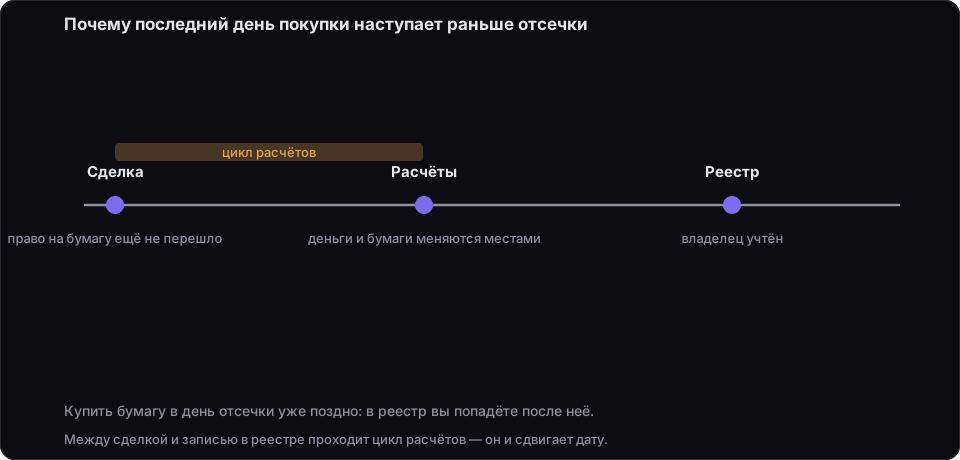
Hence the last day to buy, which falls before the record date — How to receive a dividend, step by step.
The shareholders meeting
The same mechanics apply to voting rights, with their own date. An owner who bought after the record date cannot vote at that meeting.
What an investor can see
Record dates are published in advance in the issuer's disclosure and land in the events calendar. Related: How dividends work on the Russian market.
Related instruments
Draft prepared by a language model from our stored data; not reviewed by an editor.
Model: claude-opus-5
How we use language modelsSimilar articles
- The secondary market for DFAs: why the asset never leaves its own platformA DFA can be sold before redemption only inside the platform where it was issued, and only through an exchange operator listed in the Bank of Russia register. Why the asset cannot be moved to another operator, how selling it differs from placing an order in a bond's order book, and what the sale changes in the purchase limit and in the tax.
- Terms of Trade: How the Ratio of Export to Import Prices Moves the Rouble and ProfitsThe terms of trade are the ratio between the prices at which a country sells its exports and the prices at which it buys its imports.
- TWAP order: the algorithm slices volume by time, not by liquidityA TWAP order (time-weighted average price) is an instruction to the trading system: take a large order, break it into a stream of small child orders and release them in equal portions at equal intervals until the end of a set window.
- The Impossible Trinity: What a Central Bank Pays for a Fixed Exchange RateThe impossible trinity is the proposition that, out of the set of goals "fixed exchange rate", "free movement of capital" and "independent interest rate", a state can hold any combination except the complete set.