Real return: how much actually remained
· beginner
Automated material · TradeAlmanac editorial deskPrepared by a language model from our stored data and checked by an editor.

The portfolio grew, so the investment worked. That holds until the growth is compared with the change in prices over the same period.
Nominal and real
Nominal return is the change in the amount in the account. Real return is the change in what that amount can buy. The first always looks better than the second, and the first is what gets displayed everywhere.
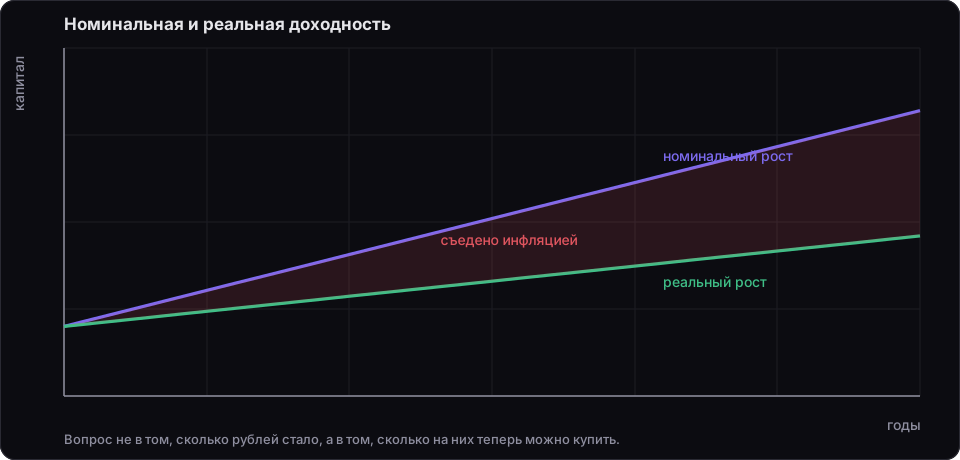
A rough calculation
Subtracting annual inflation from the annual return is enough. The exact formula accounts for the fact that return and price growth multiply rather than add, but for an estimate that difference is immaterial — unlike the difference between doing the calculation and not doing it.
Why official inflation diverges from the felt kind
The consumer price index is calculated on a fixed basket of goods and services with defined weights. Your personal basket is different.
{{figure:inflation-basket|caption=Your personal inflation differs from the official figure by exactly as much as your spending differs from the basket}}
Someone who drives a lot feels fuel prices more keenly than their weight in the index implies. Someone renting a home feels rents. Both figures are correct; they simply answer different questions.
What protects
Inflation-linked instruments are a separate class, covered in Inflation-protected bonds: how the principal is restated. Shares protect indirectly: a business passes rising costs into prices, but neither instantly nor always.
On the mechanism the central bank uses to manage inflation, see The key rate: how a Bank of Russia decision reaches your portfolio.
Prepared by a language model from our stored data and checked by an editor.
How we use language modelsSimilar articles
- The secondary market for DFAs: why the asset never leaves its own platformA DFA can be sold before redemption only inside the platform where it was issued, and only through an exchange operator listed in the Bank of Russia register. Why the asset cannot be moved to another operator, how selling it differs from placing an order in a bond's order book, and what the sale changes in the purchase limit and in the tax.
- Terms of Trade: How the Ratio of Export to Import Prices Moves the Rouble and ProfitsThe terms of trade are the ratio between the prices at which a country sells its exports and the prices at which it buys its imports.
- TWAP order: the algorithm slices volume by time, not by liquidityA TWAP order (time-weighted average price) is an instruction to the trading system: take a large order, break it into a stream of small child orders and release them in equal portions at equal intervals until the end of a set window.
- The Impossible Trinity: What a Central Bank Pays for a Fixed Exchange RateThe impossible trinity is the proposition that, out of the set of goals "fixed exchange rate", "free movement of capital" and "independent interest rate", a state can hold any combination except the complete set.